Kleidi Assist
AI that reads property documents for lawyers, and works inside the systems they already use.
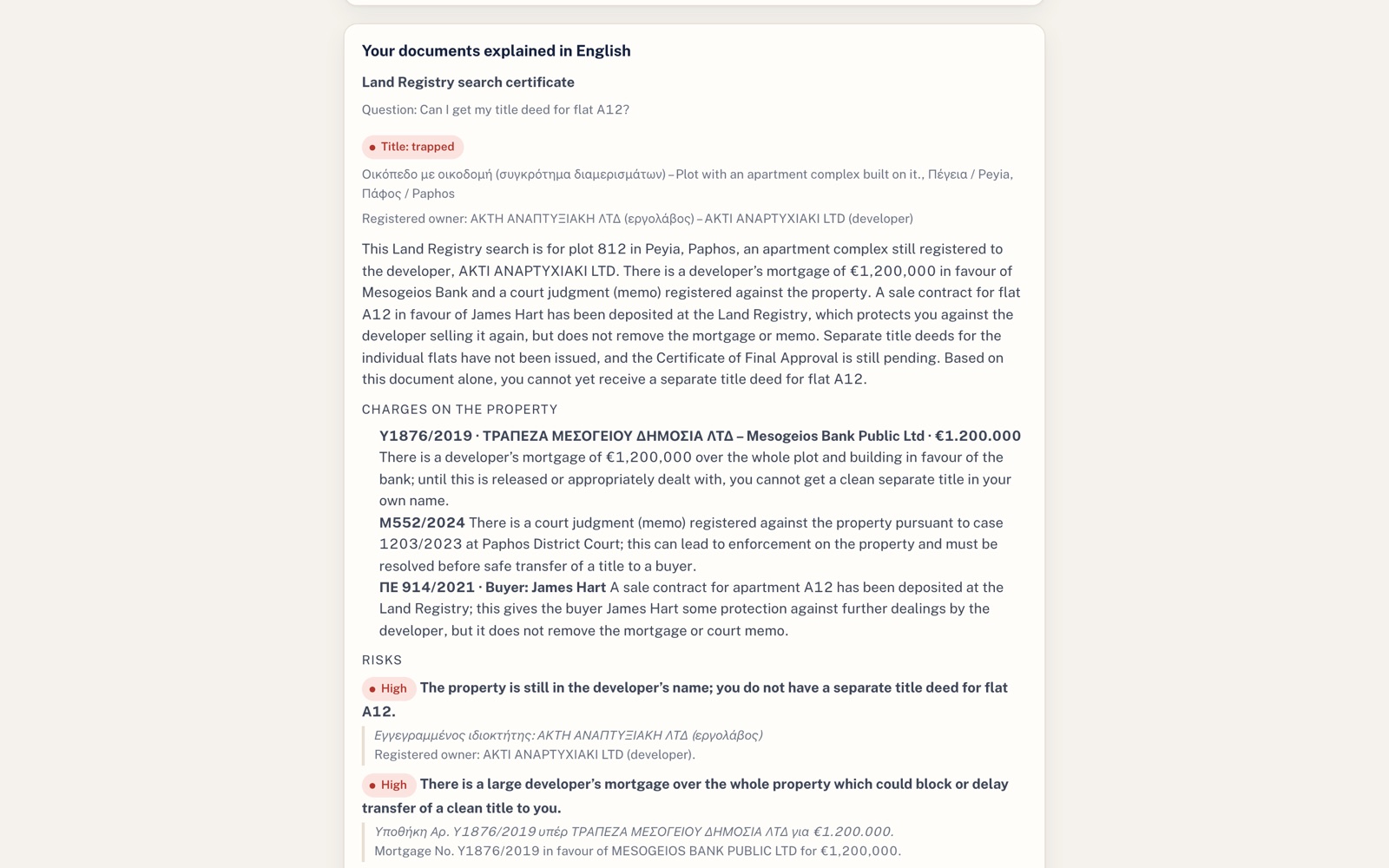
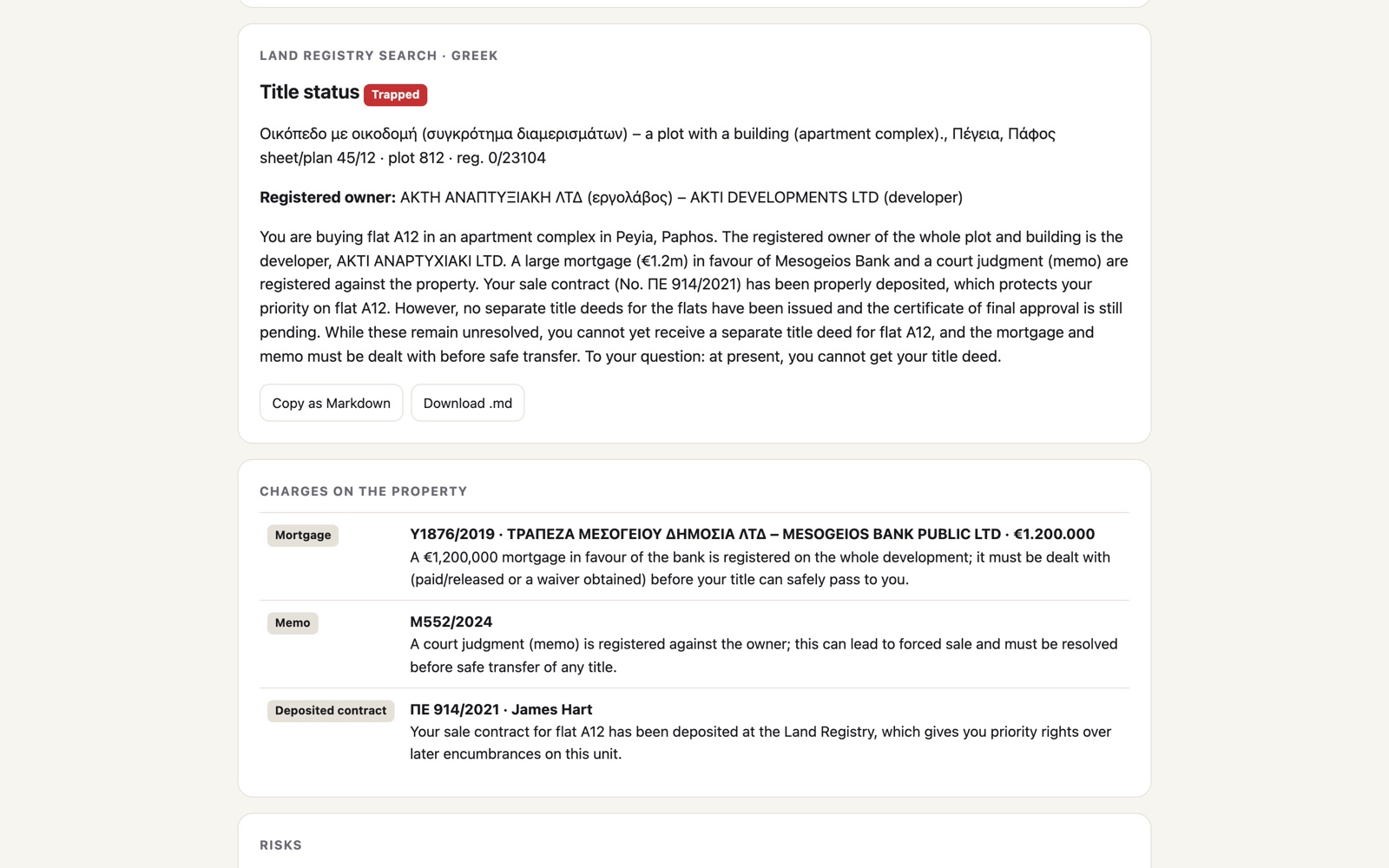
No separate titles have been issued.Ξεχωριστοί τίτλοι για τα διαμερίσματα: ΔΕΝ έχουν εκδοθεί.
Separate titles for the apartments: NOT issued.
The developer's bank holds a €1.2m mortgage.Υποθήκη Αρ. Υ1876/2019 για €1.200.000
Mortgage No. Y1876/2019 for €1,200,000
Will the bank release flat A12 from the mortgage?One of four questions for the Cypriot lawyer
The challenge
The documents that decide a sale are the hardest to read.
A UK buyer of a Cypriot flat receives Land Registry searches and contracts in Greek. The one line that says the title is trapped behind the developer's mortgage is easy to miss, and costly to find out about later.
In England and Wales, conveyancers spend hours checking the seller's replies to their enquiries, line by line, then writing follow-ups. Neither job needs a new case system. It needs help inside the one the firm already uses.
What we built
Two AI tools behind one API.
The Cyprus document explainer reads a Greek search certificate, title deed or contract, scanned or not, and explains it in plain English: the title status, every mortgage, memo and prohibition, and the questions to put to the Cypriot lawyer. The original Greek sits beside each English line, so a Greek speaker can check it.
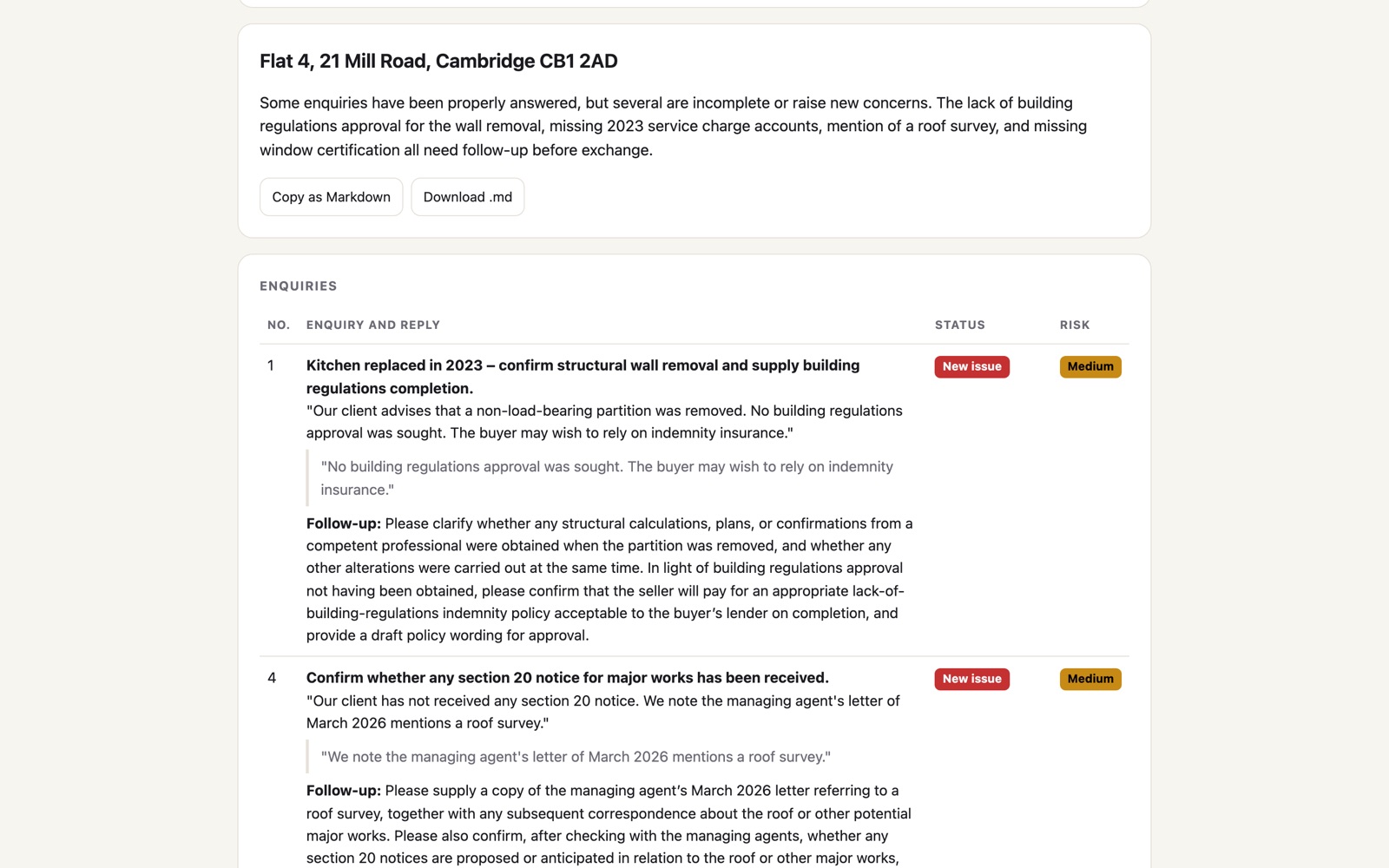
The enquiries reviewer compares the enquiries raised with the replies. It marks each one answered, partly answered, unanswered or a new issue, quotes the reply, and drafts the follow-up letter and a plain-English update for the client.
The Cyprus explainer lives in the buyer's portal in Kleidi, our platform for Cypriot property sales. The lawyer already reads Greek; the buyer often does not. So on any document their lawyer has shared, the buyer presses Explain in English and can ask a question in their own words, such as whether they can get their title deed.
Real screens
Inside Kleidi, and as a plug-in service.
Captured from the running products with fictional sample documents.
As built
Measured on the working product.
How we built it
The decisions that mattered.
- Quote the source every timeEvery finding carries the exact words it rests on, in the original language, so a lawyer checks it in seconds.
- Built for the person who cannot read itExplanations go to the buyer, not the lawyer. The buyer can only explain documents the lawyer chose to share, and only they see the answer.
- Plug in, do not replaceThe tools sit behind a small API with a key. Kleidi is the first connector, and other case systems can call the same endpoints.
- Structured answers, not chatEvery reply must match a strict schema, so it fits the case file. Refusals and cut-off replies come back as clear errors.
- Documents are data, not ordersThe model is told that anything inside a document is untrusted, so a planted instruction cannot steer it.
- Scanned before it is readOnly files that passed the virus scan are sent, from storage the firm owns. Each request goes in the case's activity log, and each sale has a cap that keeps the AI cost inside its price.
Stack
Built with.
AI service
- Node.js
- TypeScript
- OpenAI Responses API
- Zod schemas
- PDF and image input
Kleidi connector
- Fastify
- PostgreSQL RLS
- S3 storage
- ClamAV
- Event outbox
Quality
- Vitest
- Fake model client
- Fictional sample documents
- Prompt-injection guard
Let's make an impact.
Tell us what you are building. We reply within one working day with next steps and a time for a call.